
Observe
Fill events and periodic chain reads tell the bot what actually happened on the DEX.
Adaptive market making
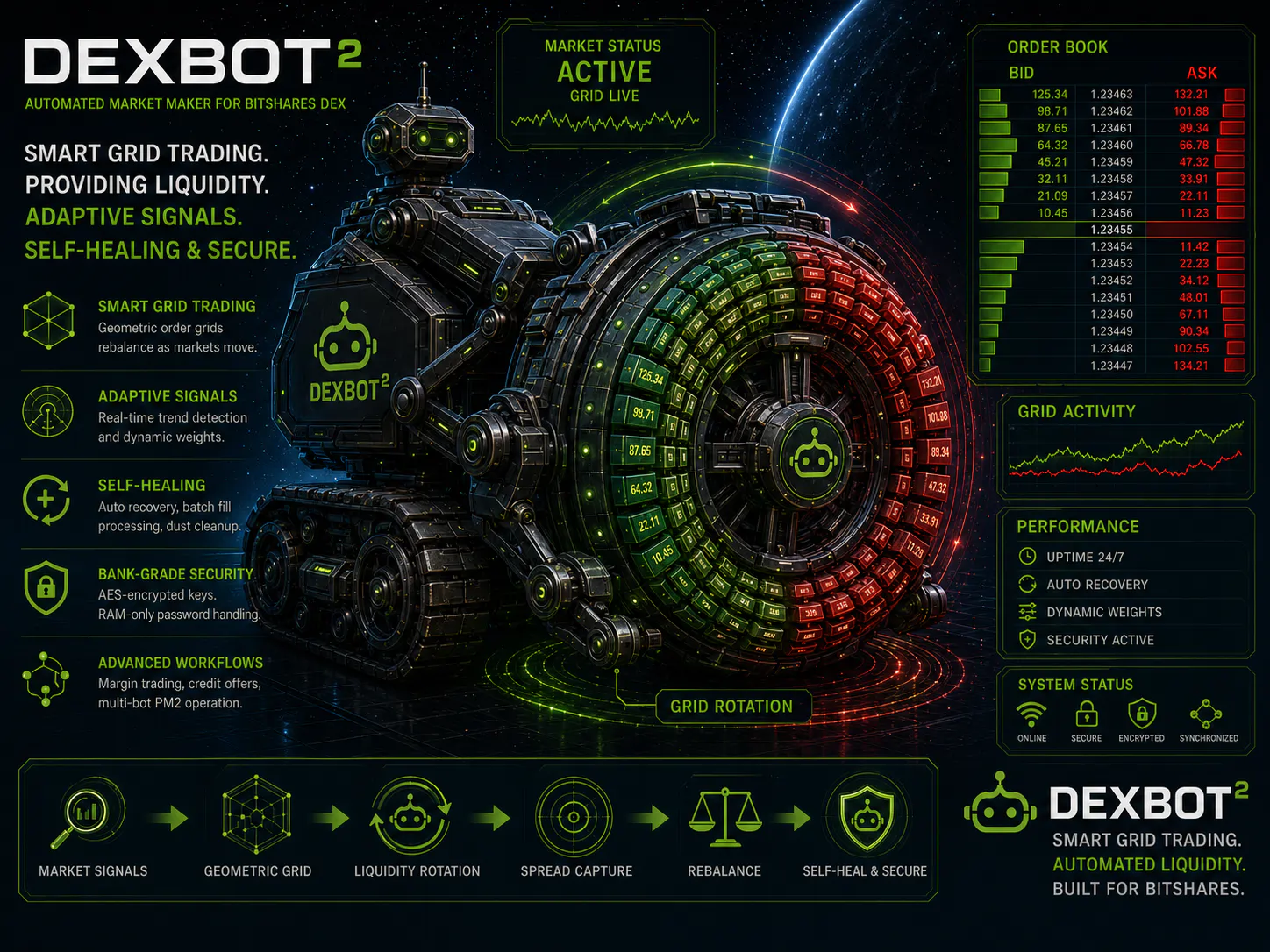
DEXBot2 is an open source market-making bot. It maintains a geometric limit-order grid, reconciles fills against on-chain state, and recalculates the grid from configurable market signals.
 System ready
The idea
DEXBot2 maintains a geometric limit-order grid around a reference price. Each fill updates the internal accounting model; the engine plans a replacement grid, broadcasts the delta, and commits only after confirmation.
That separation between market view, order state, and execution is the point. The grid can move with a fixed anchor, pool price, order-book midpoint, or AMA source without losing track of what is actually on-chain.
Platform note DEXBot2 runs on the BitShares decentralized exchange. BitShares is the execution venue, not a prerequisite for understanding the strategy.
Tighter increments increase turnover and fees. Wider spreads reduce trade frequency. The bot does not remove adverse selection, inventory risk, or execution risk.
Use the market-derived start price to enter the market, then anchor the grid to the AMA (adaptive moving average). AMA presets control how quickly the anchor follows price.
Geometric increments place buy and sell levels at changing distances from the center instead of using a flat step.
The empty zone between buy and sell orders is the room the strategy aims to capture. Fills trigger a controlled rebalance.
One controlled cycle
DEXBot2 separates observation, accounting, planning, and execution. That separation is what makes recovery and debugging possible.
Fill events and periodic chain reads tell the bot what actually happened on the DEX.
Processed-fill tracking credits a fill once, even when a recovery or retry repeats the same event.
A copy-on-write working grid calculates the new buy and sell orders without mutating the last confirmed plan.
Only after the broadcast is confirmed does the working grid become the new master grid.
What you can do
Start with the workflow you need. DEXBot2 connects market signals, capital workflows, research tools, and runtime operations in one system.
AMA pricing, grid triggers, dynamic weights, and collateral advisory signals.
Bot-scoped debt policy, MPA borrowing, and credit offer workflows.
Research runners, chart generators, and tuning helpers for AMA fitting, trend detection, bot fitting, and TradingView exports.
Reset sources and triggers for AMA deltas, range scaling, divergence correction, and fund regeneration.
Bridge setup, launcher commands, short MPA workflows, and example commands for external runtimes.
Under the hood
Generate a controlled ladder of limit orders, then rotate it from the fill-driven rebalance path. Tune spread, increment, range, and side weights without changing the runtime model.
Verify account state, order state, and bot state after startup, maintenance, or unexpected interruptions; repair drift before creating new orders.
Keep keys encrypted at rest. A credential daemon handles signing in an isolated process so raw keys stay out of the main bot process.
Replay-safe fill accounting, startup recovery, and copy-on-write rebalancing keep the runtime deterministic across restarts, retries, and partial failures.
Quick start
Use the local workflow first. Open the README when you need the complete parameter reference.
npm i -g dexbotdexbot startSet up the trading account and its active key, then import your credentials into the encrypted vault.
dexbot keyChoose a pair, set your range and spread, and start from the recommended market price and AMA anchor.
dexbot botStart in dry-run mode, inspect the grid and logs, then enable live operation deliberately.
dexbot startRecommended first configuration
Use the market price for the initial start reference and the AMA as the grid anchor. The recommended baseline is a 2× range, 2% target spread, 0.5% increment, and equal buy/sell weights.
The full README is mirrored locally as a reference. Open the local README ↗ · BitShares setup notes ↗
For serious operators
DEXBot2 is designed to be inspected. Read the strategy, understand the recovery model, and use the tools that match your operation.
Open the full documentation ↗Enable live AMA pricing, dynamic buy/sell weights, and range scaling with per-bot adapter flags.
Run credit-only mode, manage margin borrowing, and review offers with debt-first collateral ratio planning.
Understand startup reconciliation, fill recovery, copy-on-write rebalancing, dust cleanup, and log rotation.
Use the CLI, Docker images, diagnostics, JSON logs, and the Claw bridge for compatible runtimes.
Choose your path
Keep a grid active without building a full trading stack. Tune spread, increment, range, and weight distribution for your market.
See trading features ↗Study the architecture, tests, fund accounting, copy-on-write rebalancing, and runtime boundaries before extending or integrating the bot.
Study the source ↗BitShares is the exchange where DEXBot2 runs. Learn only the setup details you need: account, active key, assets, and dry-run operation.
Read the platform guide ↗Ready when you are
Use the local quick start, read the full README when needed, and make the first run deliberate.
Good to know
DEXBot2 is an open source systematic market-making bot. It generates a geometric limit-order grid, applies market-derived signals, accounts for fills, and reconciles its working state with the exchange. The bot runs on the BitShares decentralized exchange.
No database or external runtime services. DEXBot2 includes its native BitShares client, key handling, persistence, and core runtime. You need Node.js 22.12 or newer.
Yes. A bot can be configured with dry-run mode enabled, and the onboarding guide walks you through a safe first setup.
Import only the key the bot needs, protect the profile directory, and let the credential daemon handle signing. Never share private keys or passwords.
No. It is software provided as-is, without warranty. You are responsible for your account, configuration, and trades. Use it at your own risk.